Audit routing (lifecycle hooks)
When to use this
Section titled “When to use this”Use audit routing when compliance or support needs a per-decision log: which tool ran (explore, execute, compile_metric), with what args summary, plus the SQL and row count after execution. Arivie does not store audit records internally — RFC-002 routes them through lifecycle hooks to your pipeline (Axiom, Datadog, S3, etc.).
Architecture
Section titled “Architecture”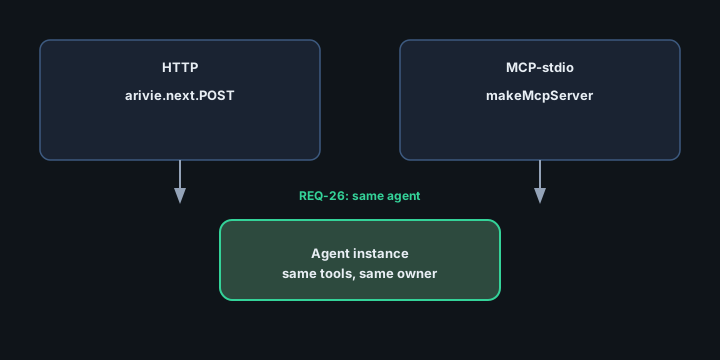
Base example: examples/with-nextjs/.
Config patch
Section titled “Config patch”Add hooks to defineArivie in arivie.config.ts. onToolCall receives tool (the tool id string) for every agent step; onAfterQuery fires after execute / compile_metric runs SQL:
defineArivie({ // ... owner, model, db, semantic, resolveUser hooks: { async onToolCall(ctx) { await auditSink.write({ event: "tool.call", tool: ctx.tool, ownerId: ctx.ownerId, userId: ctx.userId, durationMs: ctx.durationMs, }); }, async onAfterQuery(ctx) { await auditSink.write({ event: "sql.executed", sql: ctx.sql, rowCount: ctx.rows.length, ownerId: ctx.ownerId, userId: ctx.userId, durationMs: ctx.durationMs, }); }, },});The reference config shape (without hooks) is:
/* SPDX-License-Identifier: Apache-2.0 */import { dirname, join } from "node:path";import { fileURLToPath } from "node:url";import { defineArivie, type ArivieInstance } from "@arivie/core";import { postgresAdapter } from "@arivie/db-postgres";import { resolveMixpanelSource } from "./lib/mixpanel-source.js";import { makeMcpServer } from "@arivie/mcp";import type { MCPServer } from "@mastra/mcp";import { loadSemanticLayerSync, type SemanticLayer } from "@arivie/semantic";import { anthropic } from "@ai-sdk/anthropic";import { createGoogleGenerativeAI } from "@ai-sdk/google";import { createOpenAI } from "@ai-sdk/openai";import type { LanguageModel } from "ai";import { MockLanguageModelV3 } from "ai/test";
const __dirname = dirname(fileURLToPath(import.meta.url));const semanticPath = join(__dirname, "semantic");
function requireDatabaseUrl(): string {  const url = process.env.DATABASE_URL;  if (url == null || url.length === 0) {    throw new Error(      "DATABASE_URL is required — copy .env.example to .env and set your Postgres URL",    );  }  return url;}
function resolveModel(): LanguageModel {  // Preference order: Gemini (cheapest) → Anthropic → OpenAI → mock.  // Override the Gemini default via GOOGLE_MODEL (e.g. "gemini-2.5-flash").  const googleKey = process.env.GOOGLE_GENERATIVE_AI_API_KEY;  if (googleKey != null && googleKey.length > 0) {    const google = createGoogleGenerativeAI({ apiKey: googleKey });    const modelId = process.env.GOOGLE_MODEL ?? "gemini-2.5-flash";    return google(modelId) as LanguageModel;  }  const anthropicKey = process.env.ANTHROPIC_API_KEY;  if (anthropicKey != null && anthropicKey.length > 0) {    return anthropic("claude-sonnet-4-20250514");  }  const openaiKey = process.env.OPENAI_API_KEY;  if (openaiKey != null && openaiKey.length > 0) {    const openai = createOpenAI({ apiKey: openaiKey });    return openai(process.env.OPENAI_MODEL ?? "gpt-5") as LanguageModel;  }  console.warn(    "[with-nextjs] No model key set (GOOGLE_GENERATIVE_AI_API_KEY|ANTHROPIC_API_KEY|OPENAI_API_KEY) — using deterministic mock model.",  );  return new MockLanguageModelV3({    provider: "mock",    modelId: "mock",    doGenerate: {      content: [        {          type: "text",          text: "Example mock response (set GOOGLE_GENERATIVE_AI_API_KEY for a live Gemini run).",        },      ],      finishReason: "stop",      usage: { inputTokens: 0, outputTokens: 0, totalTokens: 0 },      warnings: [],    },  } as unknown as ConstructorParameters<typeof MockLanguageModelV3>[0]) as LanguageModel;}
let cached: {  arivie: ArivieInstance;  mcp: MCPServer;  semantic: SemanticLayer;} | undefined;
export async function getArivieRuntime(): Promise<{  arivie: ArivieInstance;  mcp: MCPServer;}> {  if (cached == null) {    const postgres = postgresAdapter({      url: requireDatabaseUrl(),      readOnlyRole: "arivie_reader",    });    const { adapter: mixpanel, label: mixpanelLabel } = resolveMixpanelSource();    if (mixpanelLabel.includes("mock-plan-b")) {      console.warn(`[with-nextjs] ${mixpanelLabel}`);    }    const semantic = loadSemanticLayerSync(semanticPath);    const arivie = await defineArivie({      owner: {        id: process.env.ARIVIE_OWNER_ID ?? "with-nextjs-owner",        name: "With Next.js Example",      },      model: resolveModel(),      workspace: { rootDir: semanticPath },      storage: postgres,      sources: {        postgres: {          kind: "adapter",          adapter: postgres,          description:            "Demo operational Postgres for the with-nextjs example — synthetic CRM/orders schema.",          useWhen:            "anything about customers, orders, or operational entities backed by the relational DB",        },        mixpanel: {          kind: "adapter",          adapter: mixpanel,          description:            "Mixpanel event analytics via JQL — funnels, retention, behavioral events.",          useWhen:            "any user-behavior, funnel, or product-event question that lives in product analytics, not the OLTP DB",        },      },      semantic: { path: semanticPath, mode: "preload" },      compileMetric: true, // JSON-IR routing for declared measures (arxiv 2502.00032)      resolveUser: async () => ({        userId: "demo-user",        permissions: ["analytics:read"],        dbRole: "arivie_reader",      }),    });    const mcp = makeMcpServer({      agent: arivie.agent,      semantic,      db: postgres,      ownerId: process.env.ARIVIE_OWNER_ID ?? "with-nextjs-owner",      ownerName: "With Next.js Example",    });    cached = { arivie, mcp, semantic };  }  return { arivie: cached.arivie, mcp: cached.mcp };}
Run it
Section titled “Run it”cd arivie && pnpm installpnpm --filter with-nextjs devcurl -X POST http://localhost:3000/api/arivie -H 'Content-Type: application/json' -d '{"prompt":"How many customers?"}'Verify your audit sink receives tool.call and sql.executed events for the request.