Next.js (App Router)
When to use this
Section titled “When to use this”Choose the Next.js recipe when your product is already on the App Router and you want the canonical path: defineArivie in arivie.config.ts, a thin app/api/arivie/route.ts, optional MCP at app/api/arivie/mcp/route.ts, and @arivie/react on the page. This is the reference integration the quickstart and Puppeteer harness exercise.
Architecture
Section titled “Architecture”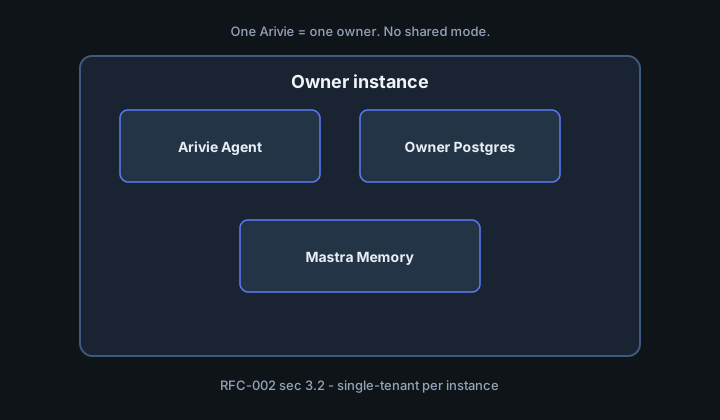
HTTP clients and the in-app chat both call the same runtime from getArivieRuntime(). MCP parity is documented in the MCP equivalence concept page.
Code snippet
Section titled “Code snippet”The API route delegates to the shared runtime — no duplicate agent construction in the route file:
/* SPDX-License-Identifier: Apache-2.0 */import { getArivieRuntime } from "../../../arivie.config";
export async function POST(req: Request): Promise<Response> {  const { arivie } = await getArivieRuntime();  return arivie.next.POST(req);}
Run it
Section titled “Run it”cd arivie && pnpm installpnpm --filter with-nextjs devcurl -X POST http://localhost:3000/api/arivie -H 'Content-Type: application/json' -d '{"prompt":"How many customers?"}'Canonical tree: arivie/examples/with-nextjs/.